
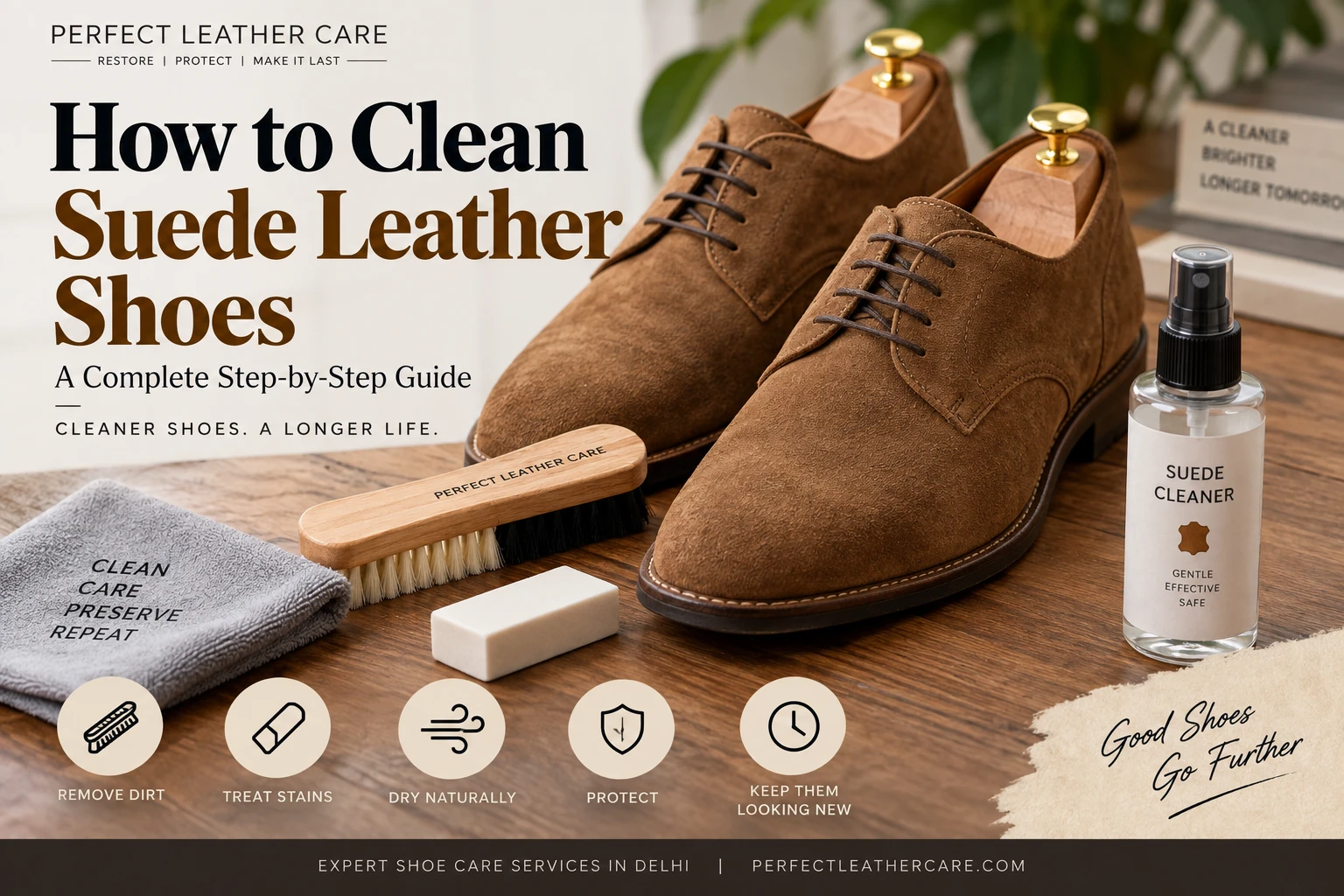
How to Clean Suede Leather Shoes Without Damaging Them
If you want to know how to clean suede leather shoes, start with one rule: do not clean suede the same way you clean smooth leather. For light dirt, begin with a suede or nubuck brush to lift loose debris and restore the nap. For deeper stains, use a cleaner specifically made for suede or nubuck, test it on a less visible area first, and allow the shoes to dry naturally.
The exact method depends on what has happened to the shoes. Dry dirt, scuff marks, oil stains and water marks should not all be treated in the same way. Major footwear brands including Clarks and Timberland provide material-specific suede-care instructions, which is why using the right method matters.
In this guide, we explain how to clean suede leather shoes at home, how to deal with common stains, what products to avoid, and when professional shoe cleaning is the safer option.
What Is Suede and Why Is It Different From Smooth Leather?
Suede is a leather material with a soft, napped surface. That textured surface gives suede shoes their characteristic appearance but also means they require different care from smooth finished leather.
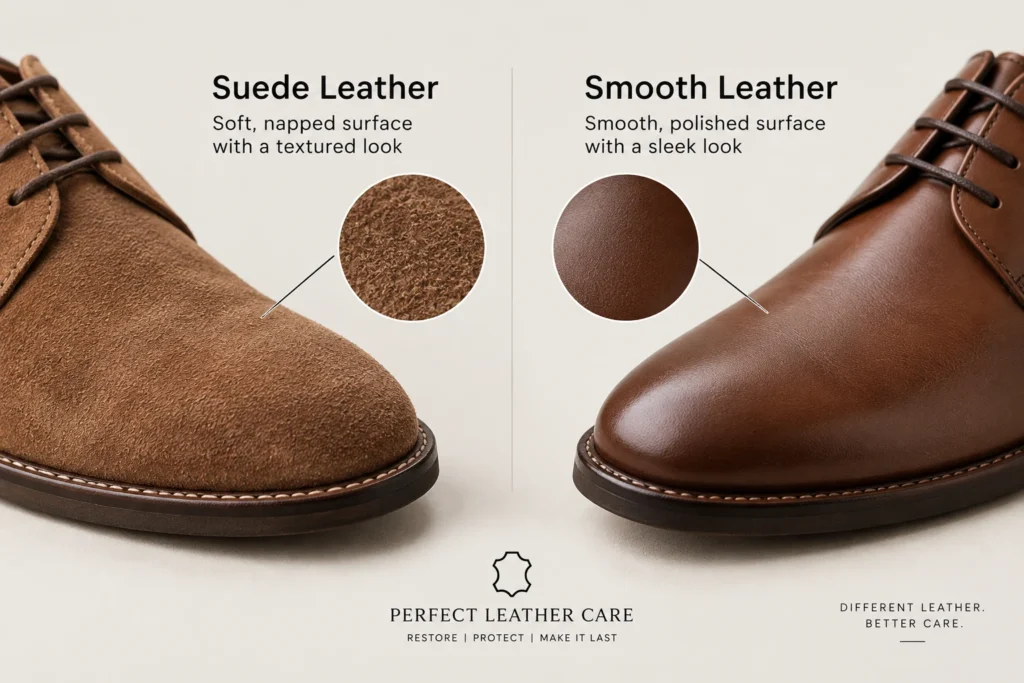
Cleaning methods should therefore be chosen according to the shoe’s material. Clarks specifically separates suede and nubuck from materials such as smooth leather, canvas and mesh when explaining shoe-cleaning methods.
This distinction is important because a product that is suitable for smooth leather may not be suitable for suede.
For example, Timberland explicitly warns that its wax product should not be used on suede or nubuck because it can damage and stain the material.
What You Need to Clean Suede Leather Shoes
For basic suede maintenance, you don’t need a complicated collection of products.
Useful items include:
- Suede or nubuck brush
- Suede-specific cleaner for deeper cleaning
- Clean, dry cloth
- Suede eraser, where appropriate
- Shoe tree or clean paper for maintaining shape
- Suede-safe protective spray
Clarks’ suede care guidance specifically recommends a suede and nubuck brush for removing loose dry dirt and offers a dedicated foaming cleaner for ingrained dirt.
Before You Start: Check the Shoe
Look at the manufacturer’s care instructions before applying any cleaning product.
Also check whether the footwear is actually suede, nubuck, or another material with a similar appearance. If you’re unsure, avoid experimenting with household cleaning chemicals on an expensive pair.
How to Clean Suede Leather Shoes Step by Step
Step 1: Remove the Laces
Take the laces out before cleaning.
This makes it easier to reach the tongue and areas around the eyelets. Clean the laces separately according to their material.
Step 2: Let Wet Mud Dry Before Brushing
If your shoes have wet mud on them, don’t immediately rub the mud across the suede.
Allow the mud to dry first. Once it is dry, loose dirt can be brushed away more easily.
The goal is to remove surface contamination without pushing it deeper into the nap.
Step 3: Brush Away Loose Dirt
Use a suede or nubuck brush to gently remove dry dirt.
Brush in the direction of the suede’s natural nap rather than aggressively scrubbing back and forth.
Clarks specifically recommends brushing stains in the direction of the natural nap and avoiding back-and-forth brushing.
For everyday maintenance, this simple step may be all that your shoes need.
Step 4: Use a Suede Cleaner for Deeper Dirt
If brushing doesn’t remove the dirt, use a cleaner specifically designed for suede or nubuck.
Follow the product instructions carefully.
For example, Clarks’ suede and nubuck cleaner instructs users to test the product in an inconspicuous area, apply it to a clean, dry cloth, work it across the surface rather than spot-cleaning only one small section, remove excess moisture or dirt with a clean cloth, and allow the footwear to dry.
This is an important distinction from the common DIY approach of applying an unknown household cleaner directly to the stain.
Step 5: Treat Scuff Marks Carefully
Light scuffs can sometimes be reduced with a suede brush or suitable suede eraser.
Work gently and check the surface frequently.
If the affected area starts looking different from the surrounding suede, stop rather than continuing to scrub. Excessive friction can change the appearance of the nap.
Step 6: Let the Shoes Dry Naturally
After cleaning, allow the shoes to dry naturally in a well-ventilated area.
Avoid trying to speed the process up with strong direct heat.
Clarks recommends air-drying footwear and keeping it away from direct heat sources.
Step 7: Brush the Nap Again
Once the shoes are completely dry, gently brush the suede again.
This helps restore the direction and appearance of the nap after cleaning.
How to Clean Suede Shoes With Water
This is where a lot of online advice becomes unnecessarily confusing.
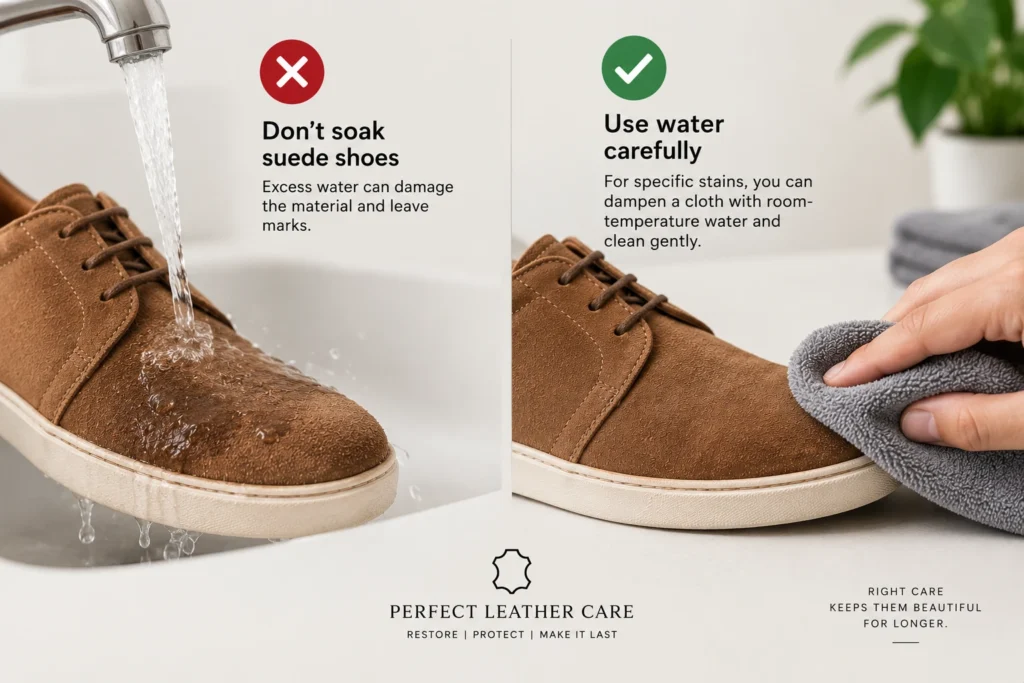
Water should not be used casually or in excessive amounts on suede, but it is also incorrect to say that water can never be used on suede under any circumstances.
The appropriate method depends on the footwear and the problem you’re trying to solve.
For example, Timberland’s official instructions for water stains on its suede boots describe dampening the affected area with room-temperature water, gently working the moisture into the area, stuffing the boots to maintain their shape, and allowing them to dry fully in a well-ventilated area.
For general cleaning, however, Clarks recommends a dedicated suede and nubuck foaming cleaner rather than simply soaking the shoes in water.
The takeaway: don’t soak suede shoes or assume that a water-based DIY method is suitable for every type of suede. Follow the manufacturer’s care instructions or use a product specifically formulated for the material.
How to Remove Water Stains From Suede Shoes
Water marks can be particularly noticeable on suede because moisture can affect the appearance of the nap and create uneven-looking areas.
If your shoe manufacturer’s instructions permit water treatment, use the recommended method rather than repeatedly wetting the shoe.
Timberland’s official suede water-stain method uses room-temperature water, gentle brushing or rubbing, stuffing to maintain shape, and complete air drying. It also specifically advises against using newspaper or paper containing ink because the ink can transfer to the footwear.
For valuable shoes or severe water staining, professional cleaning may be preferable to repeated DIY treatment.
How to Remove Oil or Grease From Suede Shoes
Oil and grease stains can be more difficult than ordinary surface dirt because they can penetrate the material.
Avoid aggressively rubbing the stain.
Instead:
- Remove any excess material carefully.
- Check the manufacturer’s care instructions.
- Use a suede-specific stain treatment if the product is suitable for your footwear.
- Test the treatment in an inconspicuous area first.
- Stop if the colour or texture begins to change.
If the stain is large, old, or has already penetrated deeply into the suede, professional cleaning is usually a better choice than experimenting with household chemicals.
Can You Use Vinegar to Clean Suede Shoes?
You may see vinegar recommended as a DIY suede cleaner online, but it should not be treated as a universal solution.
Clarks does mention diluted white vinegar as a possible last-resort treatment for stubborn suede stains, but also warns that it may affect the colour of the material.
Therefore, vinegar should not be the first thing you reach for when cleaning an expensive pair of suede shoes.
A suede-specific cleaner is the more controlled option because it is formulated for the material.
Can You Use Soap or Detergent on Suede?
Don’t assume that ordinary laundry detergent, dishwashing liquid, or household soap is suitable for suede.
Different shoe materials respond differently to cleaning chemicals. Timberland specifically recommends selecting products according to the material and warns that certain treatments suitable for other leathers can damage suede or nubuck.
For suede, use a product whose instructions specifically state that it is suitable for suede or nubuck.
Can You Use Shoe Polish on Suede?
Traditional shoe polish is generally designed to restore or add colour and shine to smooth leather.
Suede has a different surface and does not need the glossy finish associated with smooth leather.
More importantly, unsuitable products can alter the texture or appearance of suede.
Timberland specifically warns against using wax on suede and nubuck because it can damage the material and cause staining.
How to Protect Suede Shoes After Cleaning
Cleaning is only one part of suede shoe care.
Once the shoes are clean and completely dry, a suitable suede protector can help provide additional resistance against future moisture and stains.
However, check that the protector is designed for suede or nubuck and follow its application instructions.
Clarks recommends testing protective products on an inconspicuous area first because some products can slightly darken suede.
Use a Shoe Tree to Maintain the Shape
Cleaning won’t help much if your shoes are stored incorrectly afterward.
A shoe tree can help footwear retain its shape when it isn’t being worn. Clarks recommends shoe trees as part of its boot-storage guidance and notes that they help maintain shape and reduce creasing.
If you need one for your footwear, you can see the Shoe Tree available from Perfect Leather Care.
How Often Should You Clean Suede Shoes?
There isn’t one universal cleaning schedule for suede.
Instead, clean according to the condition of the footwear:
- Light dust: brush when necessary.
- Surface dirt: brush before it becomes embedded.
- Small scuffs: treat when they appear.
- Stubborn stains: use a suitable suede cleaner or professional cleaning.
- Heavy staining: consider professional treatment rather than repeated DIY cleaning.
Regular light maintenance is preferable to allowing dirt and stains to build up until aggressive cleaning becomes necessary.
What Not to Do When Cleaning Suede Shoes
Some of the most common suede-cleaning mistakes are caused by using a method designed for another material.
Avoid:
Don’t Soak the Shoes
Suede should not be treated like washable fabric footwear.
Don’t Scrub Aggressively
Hard scrubbing can affect the nap and create visibly different patches.
Don’t Use Wax Designed for Other Leather
Timberland specifically states that its wax product is not suitable for suede or nubuck.
Don’t Apply an Unknown Chemical Directly
Always check whether a cleaner is suitable for suede or nubuck.
Don’t Use Direct High Heat to Dry Them
Allow the shoes to dry naturally unless the manufacturer’s instructions say otherwise. Clarks recommends air-drying and keeping footwear away from direct heat sources.
Don’t Keep Rubbing a Stain That Isn’t Improving
If a stain isn’t responding, more friction isn’t necessarily the answer.
At that point, professional cleaning may prevent a small stain from becoming a damaged patch.
When Should You Get Professional Suede Shoe Cleaning?
Home cleaning is reasonable for routine maintenance and light surface dirt.
Professional cleaning becomes more useful when:
- The suede has deep stains.
- There are significant water marks.
- Oil or grease has penetrated the material.
- The colour has become uneven.
- The nap has become badly flattened.
- The shoes are expensive or difficult to replace.
- A previous DIY cleaning attempt has changed the colour or texture.
- You’re unsure which treatment is safe.
A professional cleaner can assess the material and condition before deciding which cleaning process is appropriate.
Professional Shoe Cleaning in Delhi
If your suede shoes have stubborn stains or you don’t want to risk damaging them with a DIY treatment, Perfect Leather Care provides professional Shoe Cleaning Service in Delhi.
Because different footwear materials require different care, the cleaning method should be selected according to the shoe’s material and condition rather than using one process for every pair.
For suede, nubuck, leather and other footwear materials, professional assessment can be particularly useful when the shoes have significant staining or require more than routine surface cleaning.
What If Cleaning Doesn’t Restore the Original Colour?
Cleaning and recolouring are two different processes.
Cleaning removes dirt, stains and other surface contamination. It does not necessarily restore colour that has genuinely faded or worn away.
If the suede or leather has significant colour loss, a restoration or recolouring process may be more appropriate. You can learn more about the Shoe Recoloring Service from Perfect Leather Care.
The right solution depends on whether the problem is dirt, staining, fading, abrasion, or actual loss of the original finish.
Frequently Asked Questions About Cleaning Suede Leather Shoes
What is the safest way to clean suede leather shoes?
For light dirt, use a suede or nubuck brush and gently remove surface debris. For deeper dirt, use a cleaner specifically formulated for suede or nubuck and follow its instructions. Always test a new product on an inconspicuous area first.
Can I clean suede shoes with water?
It depends on the footwear and the type of cleaning required. Suede should not simply be soaked in water. However, some manufacturers provide controlled water-based methods for particular problems such as water stains. Timberland, for example, gives specific instructions for treating water stains on its suede boots.
Can I use vinegar on suede?
Some manufacturers mention diluted white vinegar as a last-resort treatment for stubborn stains, but it can affect the colour. Clarks recommends treating vinegar as a last resort rather than the first cleaning option.
Can I use normal shoe polish on suede?
Traditional polish is not the same as a suede-care product. Suede requires products designed for its napped surface. Avoid wax products that are not intended for suede or nubuck; Timberland specifically warns that wax can damage suede.
How do I clean suede shoes without changing their colour?
Use a product specifically designed for suede, test it on a hidden area first, and follow the manufacturer’s instructions. Some protective or cleaning products can slightly affect colour, which is why testing is important.
How do I remove water marks from suede shoes?
Follow the shoe manufacturer’s care instructions. Some manufacturers recommend controlled treatment with room-temperature water followed by natural drying. Timberland’s official method includes maintaining the shoe’s shape while it dries.
Should I clean suede shoes myself or use a professional service?
Light dust and routine maintenance can usually be handled at home. Deep stains, oil contamination, severe water marks, colour changes, or expensive footwear are better candidates for professional cleaning.
Final Takeaway
The safest answer to “how to clean suede leather shoes” isn’t to use one universal DIY recipe.
Start by identifying the material and the type of problem. Brush dry dirt gently, use suede-specific products for deeper cleaning, test products before applying them widely, avoid unsuitable waxes and aggressive scrubbing, and let the shoes dry naturally.
Most importantly, don’t assume that advice designed for smooth leather automatically applies to suede.
For valuable or badly stained footwear, professional cleaning can be a better choice than repeatedly experimenting at home.
Perfect Leather Care can help with professional shoe cleaning and restoration in Delhi when routine suede care isn’t enough.